A few years ago, I attended a preschool showcase where children were invited to present something they enjoyed doing. Most parents expected the usual singing performances, poems, and art displays. One little boy, however, stood up and spoke passionately about dinosaurs for nearly five minutes. Another child proudly displayed a collection of leaves she had gathered and classified. A third performed a dance she had choreographed herself. What struck me was not the performances themselves, but the confidence with which each child expressed something uniquely personal.
Later, while speaking to one of the teachers, I asked how these children seemed so comfortable being themselves. Her answer was simple. “When children feel valued for who they are, they stop trying to become someone else.”
That statement captures an important truth about modern early childhood education. Every child enters the classroom with different strengths, interests, personalities, learning preferences, and talents. Yet for many years, education systems around the world often expected children to learn, behave, and succeed in largely identical ways.
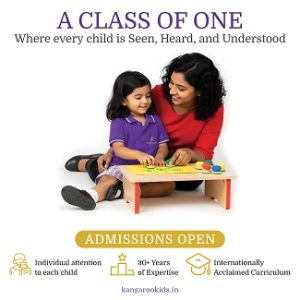
Today, educators increasingly recognise that true learning happens when individuality is celebrated rather than suppressed. At Kangaroo Kids, this philosophy sits at the heart of the learning experience. Through child-centred education and meaningful personalised learning, children are encouraged to discover their unique strengths, build confidence, and grow into capable, curious learners.
Why Individuality Matters in Early Childhood
Every child is different.
Some children are naturally talkative and expressive. Others are thoughtful observers. Some love movement and physical activity. Others are drawn to books, puzzles, music, art, or storytelling.
Recognising these differences is a fundamental principle of child-centred education.
When children feel accepted for who they are:
- Confidence grows
- Curiosity increases
- Learning becomes more meaningful
- Emotional security strengthens
Rather than trying to fit every child into the same mould, quality early childhood programs seek to understand and support each child’s individual journey.
Understanding Child-Centred Education
At its core, child-centred education places the child at the centre of the learning process.
Instead of focusing solely on what adults want children to learn, educators also consider:
- Children’s interests
- Developmental readiness
- Learning preferences
- Emotional needs
- Strengths and challenges
This approach helps children become active participants in their own learning.
At Kangaroo Kids, child-centred education informs curriculum design, classroom experiences, teacher interactions, and learning environments.
Why Personalised Learning Matters in Preschool
Many people associate personalised learning with older students. In reality, it begins during the earliest years of education.
Young children learn differently from one another.
Some children:
- Learn through movement
- Learn through observation
- Learn through conversation
- Learn through hands-on experiences
Personalised learning acknowledges these differences and allows teachers to adapt experiences based on each child’s developmental needs and interests.
This helps children engage more deeply and confidently with learning.
Helping Indian Parents Understand Learning Styles in Children
One reason personalised learning has become increasingly important is that educators now recognise the diversity of learning styles in children.
For example:
- One child may respond strongly to visual materials.
- Another may learn best through music and rhythm.
- A third may thrive through physical movement and exploration.
Understanding these differences helps educators create meaningful opportunities for every learner.
At Kangaroo Kids, teachers observe children’s interests and learning preferences carefully so that classroom experiences remain engaging and relevant.
Why Child-Centred Learning Builds Confidence
Confidence does not develop simply because children receive praise.
It develops when children experience success while being authentically themselves.
This is where child-centred learning becomes powerful.
Children gain confidence when:
- Their ideas are valued
- Their questions are encouraged
- Their efforts are recognised
- Their strengths are celebrated
These experiences create a strong foundation for self-belief.
How Kangaroo Kids Encourages Creativity in Early Childhood
Every child possesses creative potential.
However, creativity flourishes only when children feel safe enough to experiment, imagine, and express themselves freely.
Supporting creativity in early childhood means giving children opportunities to:
- Explore ideas
- Ask questions
- Solve problems
- Create independently
- Express emotions through different media
At Kangaroo Kids, creative exploration is woven into everyday learning experiences through:
- Art
- Storytelling
- Music
- Dramatic play
- Project-based learning
These opportunities allow individuality to shine naturally.
Why Emotional Development in Children Is Connected to Individuality
Healthy emotional development in children depends greatly on feeling understood and accepted.
When children feel pressured to conform constantly, they may become hesitant to:
- Express opinions
- Take risks
- Share ideas
- Show vulnerability
In contrast, environments that celebrate individuality help children:
- Build self-awareness
- Develop resilience
- Manage emotions effectively
- Communicate confidently
This emotional security supports both learning and well-being.
Supporting Social-Emotional Development Through Respect
Strong social-emotional development does not happen by accident.
Children learn empathy, cooperation, and emotional regulation through daily experiences and relationships.
At Kangaroo Kids, educators help children understand:
- Their own feelings
- The perspectives of others
- Respect for differences
- Positive communication
Celebrating individuality also teaches children to appreciate diversity within their peer group.
How Child Development Skills Grow Through Individualised Learning
Every classroom activity provides opportunities to strengthen essential child development skills.
These include:
- Communication
- Problem-solving
- Collaboration
- Creativity
- Emotional regulation
- Critical thinking
Through personalised learning, children can develop these skills at their own pace while receiving appropriate support and encouragement.
Why Holistic Child Development Requires Individual Attention
Parents increasingly seek educational environments that support holistic child development.
Holistic development recognises that children grow across multiple domains, including:
- Cognitive development
- Physical development
- Social development
- Emotional development
- Language development
A one-size-fits-all approach rarely supports all these areas effectively.
This is why child-centred education remains so valuable during the preschool years.
How Teachers Celebrate Children’s Unique Strengths
At Kangaroo Kids, teachers actively observe and document children’s interests, strengths, and developmental progress.
This allows educators to:
- Build on individual interests
- Encourage emerging talents
- Adapt learning experiences
- Support confidence-building
Rather than comparing children against one another, teachers focus on helping each child grow from their own starting point.
Read More: What Does “Holistic Development” Mean in a Preschool Context?
How to Build Confidence in Children Through Everyday Experiences
Many parents ask how to build confidence in children.
The answer often lies in everyday interactions.
Children develop confidence when adults:
- Listen respectfully
- Encourage effort
- Celebrate progress
- Value curiosity
- Allow age-appropriate independence
At Kangaroo Kids, children are encouraged to:
- Make choices
- Share ideas
- Take initiative
- Solve problems
These experiences strengthen self-belief over time.
Confidence Building in Children Through Meaningful Participation
Effective confidence-building in children happens when children contribute meaningfully to their learning environment.
Examples include:
- Leading classroom discussions
- Sharing projects
- Presenting ideas
- Participating in collaborative activities
These opportunities help children recognise that their voices matter.
Why Comparison Can Limit Growth
One of the greatest barriers to celebrating individuality is comparison.
Parents often compare:
- Academic performance
- Developmental milestones
- Behaviour
- Talents
While comparisons are natural, they can sometimes overshadow a child’s unique strengths.
At Kangaroo Kids, educators focus on growth rather than competition.
Children are encouraged to measure progress against their own development rather than against others.
Preparing Children for a Diverse World
Modern societies increasingly value:
- Creativity
- Innovation
- Adaptability
- Collaboration
These qualities flourish when individuality is respected.
Children who grow up in environments that celebrate differences often become:
- More confident
- More empathetic
- More resilient
- Better communicators
Supporting individuality during early childhood, therefore, has long-term benefits.
How Kangaroo Kids Creates a Culture of Belonging
Children thrive when they feel:
- Seen
- Heard
- Valued
- Respected
At Kangaroo Kids, creating this sense of belonging remains a central priority.
Through child-centred education, carefully designed learning experiences, strong teacher-child relationships, and meaningful personalised learning, children are encouraged to discover who they are while developing the skills they need for future success.
Read More: Apologising to Children: Enhancing Emotional Growth and Family Unity
Last Thoughts
Every child enters the world with a unique combination of strengths, interests, talents, and possibilities. Education should not seek to erase those differences. Instead, it should help children understand, appreciate, and develop them.
By embracing child-centred education and meaningful personalised learning, Kangaroo Kids creates environments where children are encouraged to be curious, confident, creative, and authentically themselves. Through supportive relationships, engaging experiences, and a commitment to holistic child development, children learn that their individuality is not something to hide. It is something to celebrate.
For families seeking learning environments that recognise each child’s unique potential, exploring the educational philosophy and admissions journey at Kangaroo Kids can provide valuable insight into how storytelling, role play, creative exploration, play-based experiences, and personalised teaching approaches help children build confidence, discover their strengths, and develop a lifelong love for learning.