A friend recently showed me a painting her four-year-old had made at preschool. She laughed as she explained that she couldn’t tell whether it was a tree, a person, or a purple dinosaur. Her daughter, however, had an elaborate explanation: it was a magical forest where trees could walk, and clouds lived underground. That conversation reminded me why children’s art should never be judged only by how recognisable the finished picture looks. The real value lies in the imagining, experimenting, choosing, changing, and storytelling happening along the way. Well-planned art activities for preschoolers permit young children to think differently, express ideas, and discover that there can be many answers to one creative question.
Why Should Indian Parents Make Space for Open-Ended Art?
Open-ended art activities for preschoolers let children choose colours, materials, shapes, and techniques independently and confidently. Instead of asking every child to make an identical flower, adults might provide paper, paint, leaves, crayons, and glue and invite them to create a garden of their imagination.
1. Paint Without a Paintbrush
Give children washable paint and unusual painting tools such as sponges, cotton buds, leaves, pieces of cardboard, or safe kitchen brushes.
Ask them to explore the marks each tool creates. Avoid demonstrating a final picture first.
This simple activity encourages experimentation and shows children that one material can be used in several ways.
2. Turn Scribbles Into Stories
Invite your child to make random lines and shapes across a page. Then look at the scribble together and ask, “What could this become?”
Perhaps a curved line becomes an elephant, a road, or a river.
Among easy drawing ideas for preschoolers, this activity develops imagination because there is no predetermined answer.
3. Create Art With Leaves
Collect fallen leaves during a walk and use them for printing, rubbing, tracing, or collage.
Children can arrange leaves as animals, faces, trees, or imaginary creatures. These art activities for preschoolers connect creativity with observation while introducing children to differences in shape, texture, and pattern.
4. Make a Recycled Materials Collage
Save clean cardboard, paper scraps, old magazines, ribbons, and child-safe packaging.
Provide glue and a large sheet of paper, then let children decide what to create.
Recycled arts and crafts for kids encourage children to see possibilities in ordinary objects while sparking conversations about reuse and waste.
5. Paint to Music
Play different kinds of child-friendly music and invite children to paint while listening.
Does slow music inspire long, gentle lines? Does energetic music lead to dots, circles, or bold movements?
There is no correct response. The activity helps children connect sound, movement, mood, and visual expression.
6. Design Your Own Rangoli
Introduce preschoolers to rangoli through large, child-friendly designs made with coloured paper, flower petals, chalk, or washable colours.
Rather than asking children to copy a complex traditional pattern perfectly, encourage them to invent their own arrangements.
Such arts and crafts for preschoolers can connect cultural traditions with pattern recognition, colour exploration, and creativity.
7. Build Cardboard Sculptures
Art does not always have to lie flat on paper.
Give children small cardboard boxes, tubes, paper cups, and child-safe tape. Challenge them to construct a robot, vehicle, house, animal, or completely imaginary object.
Three-dimensional preschool art projects introduce planning, balance, construction, and problem-solving alongside artistic expression.
8. Try Finger and Hand Painting
Finger painting gives children direct sensory contact with colour and texture.
They can blend colours, make prints, create trails, or transform handprints into imaginative pictures.
These art activities for preschoolers are especially valuable when adults resist correcting the child’s choices and let exploration guide the experience.
How Can Parents Encourage Creativity Without Taking Over?
The adult’s language matters enormously during art activities for preschoolers. Instead of saying, “Trees should be green,” try, “Tell me about your tree.” Rather than asking, “What is that supposed to be?” say, “I noticed you used lots of circles here.”
Process-focused comments show interest without judging whether artwork is good or bad.
Try asking:
- How did you make that?
- What could you add next?
- Which material would you like?
- What happened when those colours mixed?
Children then learn that their decisions matter.
Why Messy Art Can Be Valuable Learning
Paint spills, gluey fingers, scraps of paper, and imperfect shapes can make adults uncomfortable, particularly when homes have limited space. Create manageable boundaries instead of avoiding creative work entirely.
Cover a table, use washable materials, provide an old shirt, and involve children in cleaning afterwards.
The best art activities for preschoolers often involve experimentation. A child who mixes every paint colour may be investigating cause and effect, not ruining the activity.
How Kangaroo Kids Supports Creative Expression
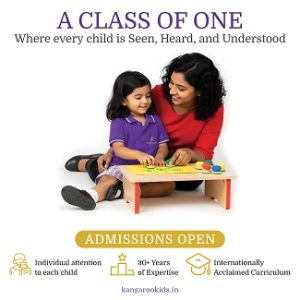
At Kangaroo Kids, young learners benefit from environments where exploration, imagination, communication, and hands-on experiences form meaningful parts of learning. Creative opportunities can help children express ideas that they may not yet have the vocabulary to explain fully.
When educators value children’s individual choices rather than expecting identical outcomes, art can support confidence, curiosity, fine motor development, problem-solving, and original thinking.
Read More: Get your creative hats on with these 15 arts and crafts project ideas
Last Thoughts
Preschool art is not about producing miniature professional artists. It helps children discover that ideas can be imagined, tested, changed, and expressed.
Give your child materials without always providing a model to copy. Let skies become orange, elephants become striped, and cardboard boxes become spaceships. Creativity grows when children feel safe enough to experiment without worrying about getting things wrong.
Meaningful art activities for preschoolers therefore focus less on the final product and more on the thinking that created it. When parents celebrate effort, curiosity, and originality, children learn that their ideas have value.
For parents looking for a preschool where creativity, communication, imaginative thinking, and hands-on discovery are encouraged within a structured learning environment, exploring admissions at Kangaroo Kids can offer useful insight into how storytelling, role-play, play-based experiences, and creative exploration are transformed into meaningful opportunities that help young children express themselves, experiment confidently, and develop a lasting enthusiasm for learning.