One evening, a child looking up from a Mumbai balcony may suddenly ask, “Where does the Moon go in the daytime?” Questions like this can turn an ordinary evening into a science adventure. The solar system is a wonderful preschool topic because it combines imagination, observation, art, counting, storytelling, and early science.
For Indian families, space learning can begin anywhere, from a city apartment to a school garden or classroom. Children can learn that the Sun is a star, planets move through space, and Earth is the planet we call home. Keep activities playful and age-appropriate, not lessons filled with difficult facts.
How Can Parents Begin With Simple Space Learning?
Start With a Colourful Solar System
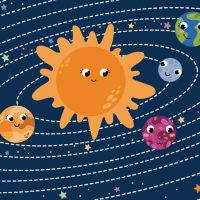
A colouring solar system activity is one of the easiest ways to introduce planets. Give children a simple outline of the Sun and planets and let them choose colours. While they work, parents can name each planet and talk about broad differences such as size, temperature, or distance from the Sun.
The goal is not perfect colouring. The activity gives children an opportunity to listen, observe, remember names, and express ideas. A colouring solar system page can also start a conversation about Earth, the Moon, stars, and night skies.
Which Space Crafts Can Preschoolers Make?
Build Planets With Simple Materials
Young children love making things with their hands. Space crafts can include paper plate planets, painted cardboard circles, foil stars, or a hanging solar system made from lightweight materials.
For a simple solar system craft, children can paint cardboard circles and arrange them from the Sun outward with adult help. They can add labels if they are ready, while younger children can simply match colours and sizes.
A solar system craft for kindergarten can also use playdough. Children can roll balls of different sizes and arrange them in sequence. This combines sensory play, fine motor practice, language, and early science.
How Can a Solar System Game Make Learning Fun?
Turn Planet Names Into Play
A solar system game can be as simple as placing planet cards around a room. Call out a planet and invite children to find its card. Another version can involve matching planet pictures with their names or arranging cards from the Sun outward.
Movement makes the experience memorable. Children can pretend to travel from Earth to another planet, count down before a pretend rocket launch, or act like astronauts exploring a new world.
These solar system activities work especially well when children are encouraged to talk, move, predict, and solve simple problems rather than only repeat information.
How Can Parents Add Maths to Space Learning?
Count, Compare, and Create Patterns
Space offers natural opportunities for early mathematics. Children can count planets, compare circles, sort objects by size, and create repeating patterns using planet pictures.
Outer space math activities can include counting stars on a page, matching numerals to groups of planets, or arranging planets from smaller to larger. Parents can also ask questions such as, “Which group has more stars?” or “What comes next in this pattern?”
What Space Science Projects Can Children Try?
Explore Shadows and Light
Preschoolers do not need complicated equipment for their first space science projects. A torch, a ball, and a darkened room can show how light creates shadows. Children can move the ball and observe how the shadow changes.
Another activity is a simple day-and-night demonstration. Use a globe or ball for Earth and a torch for the Sun. Turn the ball slowly and explain that the side facing the light experiences daytime while the opposite side experiences night.
For older kindergarten children, space science fair projects can involve creating a model of the solar system or demonstrating phases of the Moon with balls and a light source. Adult guidance is important when using electrical equipment.
How Can Colouring Support Space Learning?
Combine Art With Vocabulary
A colouring solar system page can become more than a quiet art activity. Ask children to name the planet they are colouring, describe its appearance, or find it on a classroom display.
Parents can create a second colouring solar system sheet showing only a few planets for younger children. Older children can add labels, stars, or an imagined spacecraft.
The activity also provides opportunities to practise pencil control, colour recognition, concentration, and vocabulary..
How Can Indian Parents Connect Space With Everyday Life?
Look Up at the Real Sky
India offers many opportunities for children to observe the sky. On a clear evening, families can step onto a balcony, terrace, or safe outdoor space and look for the Moon and visible stars. Parents can encourage children to describe what they see without expecting them to identify everything.
A simple observation diary can include the date, a drawing of the Moon, and a sentence about what the child noticed. Over several evenings, children may see that the Moon appears to change shape.
Read More: Engaging Planets Games for Preschoolers to Learn About Space
FAQs Parents May Ask About Kangaroo Kids
What Age Does Kangaroo Kids Recommend for Preschool?
According to Kangaroo Kids, Playgroup generally begins at age 2, Nursery at 3, Junior KG at 4, and Senior KG at 5. These programmes provide developmentally appropriate learning experiences across the preschool years.
What Learning Approach Does Kangaroo Kids Follow?
Kangaroo Kids uses the iCan Learning System and Fluidic Learning Methodology. Its curriculum includes STEAM, mathematics, language, creativity, enrichment, Future Skills, and Habits of Mind, with learning experiences designed to encourage active participation.
Last Thoughts
Space can turn a preschool afternoon into an adventure. Through crafts, games, stories, movement, counting, observation, and colouring solar system activities, children can begin building an understanding of the world beyond Earth.
For parents seeking a preschool environment that encourages creativity, communication, imaginative learning, storytelling, role play, and hands-on discovery, exploring admission at Kangaroo Kids Preschool can offer valuable insight into how meaningful experiences help young children become curious, confident, and enthusiastic learners.