Have you noticed how quickly children become absorbed when a story begins? Whenever I read to my children, I watch their expressions change as they meet a clever animal, discover something surprising, or face a difficult choice. What stays with me most are the questions that follow. Those conversations showed me that moral stories in English can be much more than entertainment. They can help children explore feelings, choices, consequences, kindness, honesty, and responsibility through characters they understand.
Why Should Indian Parents Introduce Moral Stories?
Stories are part of family life. Grandparents may share Panchatantra tales, parents may remember Aesop’s fables, and children may encounter folk stories at school. English stories with a moral let children hear English naturally while thinking about values.
Moral stories in English can connect generations. A story told in English can be discussed in Hindi, Marathi, Bengali, Tamil, or another home language, making the lesson accessible while developing vocabulary.
How Can Parents Choose Age-Appropriate Stories?
Choose stories according to age, attention span, vocabulary, interests, and emotional readiness. Preschoolers do not need complicated plots. A character, problem, and resolution are enough.
An English short story with a moral works well because children can follow the sequence. Look for positive examples, gentle consequences, and questions.
Should Parents Choose Traditional Tales?
Panchatantra stories, Aesop’s fables, Jataka tales, and regional Indian folk stories can introduce values while connecting children with cultural traditions. Families can introduce stories from other countries.
What Life Lessons Can Children Learn?
Moral tales in English can introduce honesty, empathy, patience, courage, generosity, cooperation, respect, and responsibility without sounding like a lecture. Children can observe choices and consequences.
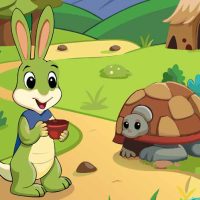
The Tortoise and the Hare
The hare was proud of being the fastest animal in the forest. He laughed at the tortoise for moving slowly and challenged him to a race. The hare ran far ahead, rested under a tree, and fell asleep. The tortoise continued steadily. When the hare woke and rushed towards the finish line, the tortoise had already arrived.
Moral: Steady effort and patience can be more valuable than confidence without discipline.
The Boy Who Cried Wolf
A young shepherd looked after sheep near a village. One day, he shouted that a wolf was attacking to amuse himself. Villagers hurried to help, but no wolf was there. He repeated the trick. Later, a real wolf appeared. The boy cried for help, but the villagers no longer believed him. The wolf scattered the sheep.
Moral: If we repeatedly lie, people may stop trusting us when we genuinely need help.
The Lion and the Mouse
A lion caught a tiny mouse and was about to eat it. The mouse pleaded for its life and promised it might help one day. The lion released it. Later, the lion became trapped in a hunter’s net. The mouse heard his roar and gnawed through the ropes until he was free.
Moral: Kindness matters, and even someone who seems small can make a meaningful difference.
The Fox and the Grapes
A fox was very hungry when he saw grapes hanging from a vine. He jumped repeatedly, trying to reach them, but they were too high. After several attempts, he walked away and said the grapes were probably sour anyway. The fox failed to reach what he wanted, but instead of accepting his failure, he changed his explanation on the spot. The story teaches children that it is better to accept disappointment honestly than pretend something was unwanted.
Moral: It is better to accept disappointment honestly than to dismiss something simply because we cannot have it.
How Can Parents Discuss the Lessons?
After reading, let children explain what they noticed. Ask, “Why did the hare lose?” or “Why did the villagers stop believing the boy?” A short story with a moral can encourage children to think about different viewpoints.
Connect lessons with everyday situations, such as sharing toys or telling the truth after a mistake.
How Can Stories Strengthen English Language Skills?
Stories introduce vocabulary, descriptions, dialogue, sequence words, and expressions. Repetition gives children opportunities to recognise and use new words.
In multilingual Indian homes, stories can gently bridge languages. Discuss a new English word in the family’s home language, then return to the story. Small moral stories in English are especially convenient for busy evenings because parents can read one in a few minutes.
How Can Indian Parents Turn Stories Into Everyday Activities?
After reading, invite your child to draw a character, act out a scene, arrange events, or invent another ending. Ask them to retell it to a grandparent or sibling.
Short and moral stories in English can become starting points for family conversations about sharing toys, waiting for a turn, helping at home, respecting others, and caring for animals.
Read More: Everything You Need to Know About Moral Development of Preschoolers
FAQs
What Are the Benefits of Storytelling for Preschoolers?
Kangaroo Kids says storytelling can build vocabulary, comprehension, creativity, empathy, memory, and communication. It also gives children opportunities to participate actively in narratives rather than remaining passive listeners.
How Does Kangaroo Kids Approach Early Learning?
Kangaroo Kids uses the iCan Learning System, which includes Future Skills, Habits of Mind, language, creativity, mathematics, STEAM, and enrichment. Its Fluidic Learning Methodology keeps learning experiences flexible and responsive to children’s individual strengths and needs.
Last Thoughts
The greatest value of moral stories in English is not that children can repeat a lesson word for word. It is that stories give them opportunities to think, question, empathise, imagine, and discuss choices. Whether you choose an Indian tale, fable, or story from another culture, the conversation can make it meaningful.
Regular English stories with a moral can combine language practice with values and connection. When children share their ideas, reading becomes part of everyday learning.
For parents who want to nurture creativity, communication, and imaginative learning, exploring Kangaroo Kids Preschool’s admission process can offer useful insight into how storytelling, role-play, and play-based experiences support young children’s learning, expression, confidence, and development.