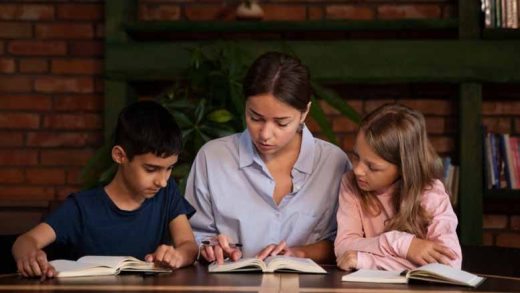
Recently, while helping my niece with her schoolwork, I asked her to write about her family. She immediately began describing her grandmother’s stories, her brother’s games, and the lunches they enjoyed together. What started as a writing exercise soon became a conversation about the people she loved.
A “My family” essay gives children a familiar subject through which they can practise vocabulary, sentence formation, sequencing, and self-expression. For Indian children, family stories may include parents, grandparents, siblings, cousins, traditions, celebrations, and everyday moments shared together.
How Can Parents Help Children Plan Their Ideas?
Start With People, Not Sentences
Before beginning a “My family” essay, encourage your child to talk about family members. Ask simple questions. Who lives at home? Who do you enjoy spending time with? What does your family like doing together? What makes your family special?
A mind map can make writing easier. Write “Family” in the centre and add branches for relatives, activities, celebrations, meals, and memories. Children can choose the ideas they want to include.
This approach can also support paragraph writing about “my family” because children learn to group related ideas before turning them into sentences.
What Should Children Include in a Family Essay?
Build the Introduction First
The opening of a my family essay should introduce the family simply. A child might write about how many people are in the family and mention who they are.
The introduction does not need complex vocabulary. A sentence such as “I live with my parents and my younger brother” provides a clear beginning. Children can add details about interests or routines.
For younger learners, parents can discuss facts and opinions. “My grandmother lives with us” is a fact, while “My grandmother tells funny stories” expresses a personal observation.
How Can Children Describe Family Members?
Add One or Two Details About Each Person
A strong my family and i essay does not need a long description of every relative. Encourage children to choose one or two memorable details. They might describe a parent’s favourite activity, a sibling’s hobby, or a grandparent’s special tradition.
Children can use adjectives such as kind, cheerful, helpful, funny, caring, patient, or hardworking. Encourage examples.
This makes a family essay more personal and helps children move beyond lists of names.
How Can Indian Parents Add Cultural Details?
Use Familiar Family Experiences
A “My family life” essay can include experiences that are meaningful to the child. Indian families may celebrate Diwali, Eid, Christmas, Holi, Onam, Pongal, Baisakhi, or other festivals depending on their traditions. Children can describe preparing food, visiting relatives, decorating the home, sharing meals, or spending time together.
Every family has different traditions, so children should write about experiences that belong to their own lives. A family holiday, birthday, or visit to grandparents can be meaningful.
How Can Parents Teach Children to Write Ten Lines?
Give Them a Simple Structure
When a teacher asks students for 10 lines on my family, children can use a straightforward sequence. Begin with the family size, introduce family members, describe what they enjoy doing together, mention a special memory, and finish with a sentence expressing appreciation.
A “My family” essay of 10 lines model can follow this structure:
- I live with my family.
- My family loves and supports me.
- I live with my parents and sibling.
- We enjoy spending time together.
- My family celebrates special occasions together.
- We help one another every day.
- I enjoy talking and playing with my family.
- We share meals and stories.
- My family teaches me important values.
- I feel happy and safe with my family.
Adapt these lines to match the child’s real family.
How Can Children Make Their Writing More Interesting?
A personal memory can make a “My family” essay engaging. Ask the child to remember a picnic, holiday, festival, family meal, or visit to a relative. Encourage them to describe what happened and why they enjoyed it.
Parents can ask questions instead of supplying sentences, helping children develop their voice.
At Kangaroo Kids, the learner-centric approach encourages children to explore, communicate, create, and develop their individual strengths. Its iCan Learning System and Fluidic Learning Methodology make learning adaptive and meaningful. This approach supports activities where children express ideas in their own words.
How Can Preschool Learning Support Writing Skills?
Connect Speaking, Stories, and Writing
Young children often develop writing ideas through speaking first. Encourage your child to tell the family story aloud before writing it. Once the story is clear, help them organise it into an introduction, a few details, and a conclusion.
At Kangaroo Kids, language learning includes opportunities to acquire, comprehend, interpret, and present information, helping children become effective communicators. This emphasis on communication supports early writing by giving children opportunities to express ideas.
Read More: Promoting the Importance of Giving in Family and Community Life
FAQs Parents May Ask About Kangaroo Kids
– What Is the Best Age to Start Preschool?
According to Kangaroo Kids, the best age to begin Playgroup is 2 years, while Nursery generally begins at 3 years. Junior KG follows at 4 years and Senior KG at 5 years.
– What Learning Approach Does Kangaroo Kids Use?
Kangaroo Kids uses the iCan Learning System and Fluidic Learning Methodology. Its curriculum includes Future Skills, Habits of Mind, language, creativity, mathematics, STEAM, and enrichment experiences.
Last Thoughts
A “My family” essay is more than a classroom writing exercise. It gives children a familiar personal subject through which they can practise describing people, organising thoughts, remembering experiences, and expressing feelings.
Whether a child is writing a short composition about “My family”, a longer personal piece, or a simple ten-line response, the goal should be clear communication, not complicated vocabulary. Parents can encourage children to speak, brainstorm, and draw before writing.
For parents seeking a preschool environment where creativity, communication, storytelling, role-play, and imaginative learning are part of everyday experiences, exploring admission at Kangaroo Kids Preschool can offer valuable insight into how children develop confidence in expressing ideas and turn familiar experiences into meaningful learning opportunities.