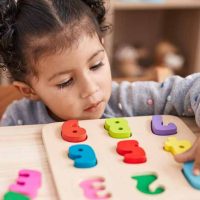
One evening, I was walking with my children when my 4-year-old suddenly exclaimed, “Look mom, that is a ‘rectangle’ window!” My heart beamed with pride at his observation. Since then, we’ve turned our ordinary walks around our neighbourhood into a little shape hunt.
We noticed round plates through a restaurant window, rectangular doors, triangular road signs, and square tiles beneath our feet. That experience shows me that learning shape names doesn’t have to start with worksheets. For young children, shapes become meaningful when connected to familiar objects, play, and everyday discoveries.
Why Should Indian Parents Teach Children Shape Names?
Learning shapes helps children notice how objects look, fit together, and relate to one another. Recognising the names of shapes supports early mathematical thinking, spatial awareness, and vocabulary.
For Indian families, everyday surroundings provide countless examples. Children can notice circles on rotis, rectangles on doors, squares in floor tiles, and triangles in decorations. Learning names of shapes becomes easier when children can connect each word with something they already know.
What Are the Basic Shapes Children Should Learn?
Start with a small group of familiar forms rather than introducing too many at once. Children can learn shapes and names by looking, touching, drawing, sorting, and comparing.
Circle
A circle is round and has no corners. Children may find circles on plates, bangles, wheels, and clocks.
Square
A square has four equal sides and four corners. Tiles, windows, and boxes can help children recognise one.
Rectangle
A rectangle has four sides, with opposite sides equal in length. Books, doors, screens, and notebooks are familiar examples.
Triangle
A triangle has three sides and three corners. Children may notice triangles on road signs, bunting, and rooftops.
Then teach them about more complex shapes, such as an oval, diamond, star, and semicircle.
How Can Parents Teach Shapes Through Everyday Objects?
Instead of asking children to memorise a list, encourage them to look around. Ask, “Can you find something shaped like a circle?” or “Which object looks like a rectangle?”
This approach makes names of shapes with pictures especially useful when combined with real objects. A picture can show a square, but a square tile lets children see and touch the concept. Add the name in shape activities by matching labels with objects.
Can Indian Festivals Make Shape Learning Fun?
Absolutely. Rangoli patterns can contain circles, triangles, squares, diamonds, and repeated designs. Paper decorations, diyas, kites, gift boxes, and festival cards can also become opportunities to identify shapes.
How Can Parents Explain the Difference Between Shapes?
Young children may initially confuse a square and a rectangle or call every round object a circle. Avoid treating mistakes as failures. Compare the shapes gently.
Ask children to notice sides and corners. A triangle has three sides, a square has four equal sides, and a circle has no corners.
How Do Shapes Support Early Mathematics?
Shapes are part of broader mathematical thinking. Children learn to recognise patterns, sort objects, compare features, and understand relationships.
The Kangaroo Kids mathematics programme uses an E-L-P-S approach that connects Experience, Language, Picture, and Symbol. Its curriculum links mathematical concepts to real-world situations. This means a child can first experience a shape through an object, learn its name, recognise its picture, and eventually connect it with a mathematical representation.
What Shape Activities Can Indian Parents Try at Home?
A simple shape hunt can turn learning into a game. Give your child one shape and ask them to find five examples around the house. A sorting game can involve buttons, bottle caps, blocks, or safe household objects.
Children can also make shapes using play dough, sticks, paper strips, or craft materials. Ask them to build a house from rectangles and triangles or create a picture using circles and squares.
Can Drawing Help Children Remember Shapes?
Yes. Encourage children to draw one large shape, trace its outline, colour it, and then turn it into something recognisable. A circle can become a sun, a square a window, and triangles mountains.
How Can Parents Use Shapes to Build Vocabulary?
Every shape activity can become a language activity. Encourage children to say the shape name aloud, describe its features, and compare it with another shape.
You can ask, “What shape is this?” “How many corners does it have?” or “Where have you seen this shape before?” These conversations build descriptive language alongside mathematics.
How Does Kangaroo Kids Approach Shape Learning?
Kangaroo Kids includes shapes in its preschool maths curriculum and encourages learning through hands-on exploration. Its wider curriculum uses play, experimentation, creativity, and real-world experiences to make concepts meaningful.
The preschool programme also gives children opportunities to think, ask questions, and build their own learning through learning stations. This supports an approach where children can investigate shapes rather than simply repeat their names.
Read More: Creative Shape Craft Ideas for Preschoolers
FAQs
What Mathematical Concepts Do Preschoolers Learn at Kangaroo Kids?
Kangaroo Kids introduces early mathematical ideas such as counting, recognising shapes, understanding patterns, sorting, and comparing through hands-on activities and games. Its approach connects mathematical concepts with real experiences.
How Does Kangaroo Kids Support Different Learning Needs?
Kangaroo Kids uses a Fluidic Learning Methodology that keeps the what, how, and when of learning flexible. The approach recognises that every child has individual strengths and develops at their own pace.
Last Thoughts
Learning the names of shapes is a small but important part of early mathematical development. When children recognise circles on bangles, rectangles on books, triangles in decorations, or squares in tiles, abstract vocabulary becomes connected to their world.
Parents do not need elaborate resources. Everyday objects, conversations, drawing, building, sorting, and shape hunts can provide meaningful practice. The goal is to help children observe, compare, describe, and make connections. Play makes this learning memorable for young children every day.
Parents who want to encourage creativity, communication, and imaginative learning in a structured environment can explore Kangaroo Kids Preschool’s admission process to learn how play-based experiences, exploration, and hands-on learning help young children build confidence while making early concepts meaningful.