Recently, I was invited to a children’s reading event at a local bookstore, where I had the joy of reading stories aloud to a lively group of young children. As soon as I began telling The Tortoise and the Hare, their faces lit up.
Some predicted who would win, others cheered for their favourite character, and a few interrupted with wonderfully unexpected questions. What stayed with me was how naturally the children became part of the story.
That experience reinforced in me how a familiar story can encourage English practice, conversation, imagination, and thoughtful learning while making reading feel joyful and shared.
How Can Parents Introduce the Story?
Before reading, ask children what they know about a tortoise and a hare. Which animal do they think moves faster? Which one moves slowly? What might happen if they had a race?
These questions create curiosity. The tale is about persistence, focus, and avoiding overconfidence.
What Happens in The Tortoise and the Hare?
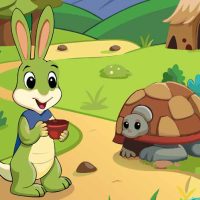
One day, a hare laughs at a tortoise because the tortoise moves slowly. The tortoise remains calm and challenges the hare to a race. The hare agrees, confident that winning will be easy.
The race begins. The hare quickly runs far ahead, while the tortoise continues moving at a steady pace. Seeing how far behind the tortoise is, the hare becomes overconfident. He decides to rest for a while.
The tortoise does not stop. He keeps walking slowly and steadily along the path. While the hare sleeps, the tortoise keeps moving toward the finish.
Eventually, the tortoise reaches the finish line. The hare wakes up and runs as fast as he can, but he is too late. The tortoise has already won the race.
The story teaches that steady effort can matter more than speed without focus.
What Is the Moral of the Story?
The central lesson of the tortoise and the hare is that patience, consistency, and determination matter. Natural ability does not guarantee success without focus.
Children can understand this lesson through everyday examples. A child learning to write may improve through regular practice. A child learning to ride a bicycle may need to try again and again. A child completing a puzzle may discover that patience helps more than rushing.
Parents can ask, “Why did the tortoise win?” and “What could the hare have done differently?” Such questions encourage children to explain their ideas.
How Can Parents Use the Story for English Learning?
Build Vocabulary Through Storytelling
The tortoise and the hare story in English includes vocabulary parents can revisit with pictures and actions. Words such as race, slow, fast, walk, run, finish, sleep, and win can be introduced naturally.
Children can act out the words by walking, running, pretending to sleep, and celebrating.
This makes language memorable because children hear, see, and physically experience the words.
Encourage Prediction
Pause before important moments. Ask, “What do you think will happen next?” When the hare runs ahead, ask whether the tortoise can still win.
Prediction encourages listening, reasoning, and imagination. It also makes children active participants in storytelling.
Why Is Reading Aloud Valuable for Preschoolers?
Regular reading aloud helps children hear sentence patterns, learn new vocabulary, and understand how stories are organised. English storybooks can introduce children to different characters, settings, problems, and solutions.
A short story helps children learn. Ask children to retell its beginning, middle, and ending in their own words.
How Can Indian Parents Connect the Story With Everyday Life?
Connect the story with home and school. Ask whether your child has rushed and made a mistake, then discuss how practice can improve results.
Connect it with sports, drawing, music, or learning letters. Regular practice can matter more than immediate perfection.
The hare laughs at the tortoise, giving parents an opportunity to discuss why teasing is unkind.
Can Children Act Out the Story?
Try a Simple Race Game
Create a short indoor or outdoor pathway. One child can pretend to be the tortoise and another the hare. Let them act out the story, then switch roles.
Keep it playful rather than competitive. Children practise movement, sequencing, listening, and cooperation.
Make Character Puppets
Paper, cardboard, or recycled packaging can become simple animal puppets. Children can draw the tortoise and hare and use them to retell the story.
This supports fine motor skills, creativity, and vocabulary.
What Can Parents Ask After Reading?
After reading the story of the hare and tortoise in English, ask: Who was faster? Who kept going? Why did the hare stop? What would you do?
You don’t need to demand one perfect answer. Encourage children to explain their thinking.
How Does Kangaroo Kids Support Story-Based Learning?
Kangaroo Kids encourages children to learn through exploration, creativity, communication, storytelling, and play. Its preschool approach gives children opportunities to ask questions, experiment, create, discover, and engage in role-play.
Stories such as The Tortoise and the Hare fit naturally into this approach.
Read More: Building a Strong Foundation for Early Literacy Without Pressure
FAQs
What Ages Does Kangaroo Kids Cater To?
Kangaroo Kids offers Playgroup for children aged 2 to 3, Nursery for ages 3 to 4, Junior KG for ages 4 to 5, and Senior KG for ages 5 to 6.
What Learning Approach Does Kangaroo Kids Follow?
Kangaroo Kids uses its iCan Learning System and Fluidic Learning Methodology to support child-centred learning through exploration, creativity, communication, and play-based experiences.
Last Thoughts
The tortoise and the hare remains popular because its message is simple enough for young children while offering plenty of opportunities for deeper conversations. The story encourages patience, persistence, humility, and respect.
Whether your child hears the tale as the tortoise and the hare, or the rabbit and the tortoise, the central message remains useful. Success isn’t always about being the fastest. Sometimes it comes from continuing steadily when others stop.
For parents who want to encourage creativity and communication through stories and play, exploring Kangaroo Kids Preschool’s admissions process can offer insight into how play-based experiences build meaningful learning.