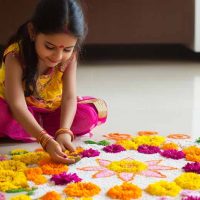
It is amazing how a simple rangoli can transform a home’s entrance during Diwali. What fascinates me most is watching children gather around, choose colours, suggest patterns, and eagerly add their own little touches. For parents, rangoli can be much more than a festive decoration. It can become a playful way to explore colours, shapes, symmetry, patterns, creativity, and family traditions. Rangoli designs for Diwali let children participate in the celebrations in a hands-on way. With a few simple materials and plenty of imagination, even young children can enjoy creating their own designs.
How Can You Choose a Rangoli Design for Your Child?
When selecting rangoli designs for Diwali, consider your child’s age, attention span, and motor skills. Preschoolers may enjoy large, simple patterns they can colour or decorate without worrying about precision. Older children can try more detailed shapes, repeating patterns, or symmetrical designs.
The goal is not perfection for children. Give children freedom to experiment, make choices, and explain their ideas.
Which Simple Rangoli Ideas Can Young Children Try?
Why Not Try a Dot-Based Rangoli?
Dots provide an easy starting point for children. Place large dots on the floor in a simple arrangement, then invite your child to connect or decorate them with coloured powder or chalk. Begin with a square, circle, or flower shape.
A dot-based Deepavali rangoli design can introduce counting, sequencing, and spatial awareness. Ask children how many dots they see and which colours they want to use.
How to Create a Flower Rangoli
Flowers are familiar and visually appealing to young children. Draw a large flower outline and let children fill the petals with coloured powder, rice, pulses, or flower petals.
A flower design for rangoli can become a conversation about nature. Ask children to identify flower colours and compare petal shapes.
How Can Parents Make Rangoli Activities Easier?
Use Household Materials
You do not need specialised rangoli supplies. Coloured rice, flour mixed with food-safe colouring, chalk, flower petals, pulses, or recycled paan be used for supervised activities.
For younger children, a paper rangoli may be easier and safer. Give them an outline and let them decorate it.
Start With Simple Shapes
Circles, triangles, squares, leaves, petals, and stars are easy for preschoolers to recognise and repeat. Combining two or three shapes can create attractive designs.
These simple Deepavali rangoli designs can also support early mathematics. Children can count petals, identify shapes, compare sizes, and create repeating sequences.
How Can Indian Parents Connect Rangoli With Diwali Traditions?
Rangoli is associated with welcoming guests, decorating homes, and celebrating special occasions. Designs and materials vary across regions, and families may have their own traditions.
Show children different patterns and ask what they notice. Explain that families may use coloured powders, flowers, rice, or natural materials.
While creating easy Diwali rangoli designs, parents can discuss family memories and regional customs. This helps children understand that festivals can be expressed in different ways.
How Can Rangoli Support Early Learning?
Rangoli activities naturally combine several areas of development. Drawing outlines strengthens fine motor control. Picking up petals develops hand coordination. Repeating patterns supports early mathematical thinking, while describing a design builds vocabulary.
Kangaroo Kids encourages children to learn through exploration, creativity, communication, and hands-on experiences. Its preschool approach gives children opportunities to create, discover, experiment, ask questions, and express ideas.
A rangoli activity reflects this philosophy because children actively make choices rather than simply watching.
How Can Parents Encourage Creativity Instead of Perfection?
Children may place colours outside the lines or invent unexpected shapes. Let them. Ask, “Why did you choose this colour?” or “What would you like to add next?”
Invite your child to design a rangoli on paper first. This gives them an opportunity to plan and make independent decisions.
Beautiful rangoli designs for Diwali can inspire children, but examples should be starting points, not templates.
What Rangoli Activities Can Families Enjoy Together?
Create a family rangoli where each person contributes one section. One child might arrange flowers, another might colour, while parents create the outline. This makes the activity collaborative.
Try a colour challenge using only three shades. Another idea is a nature rangoli made with fallen leaves and flower petals collected safely with an adult.
For younger children, create a mini rangoli on a tray to keep the activity manageable.
How Can Kangaroo Kids Connect Festival Learning With Creativity?
Kangaroo Kids uses a child-centred approach that values exploration and creative expression. Its programmes encourage children to think, ask questions, experiment, imitate, practise, and engage in role-play.
Festival activities such as rangoli can complement these experiences by giving children opportunities to observe patterns, make decisions, communicate ideas, and work with others. Parents can focus on the process rather than the finished picture.
Read More: 10 Interesting Facts About Diwali for Kids
FAQs
What Ages Does Kangaroo Kids Cater To?
Kangaroo Kids offers Playgroup for children aged 2 to 3, Nursery for ages 3 to 4, Junior KG for ages 4 to 5, and Senior KG for ages 5 to 6.
What Learning Approach Does Kangaroo Kids Follow?
Kangaroo Kids uses its iCan Learning System and Fluidic Learning Methodology to support child-centred learning through exploration, communication, and play-based experiences.
Last Thoughts
Creating rangoli designs for Diwali can become a joyful family activity that combines culture, creativity, and learning. Children can explore colours, shapes, patterns, textures, and teamwork while participating in a familiar Indian tradition.
Simple rangoli designs for Diwali can give children freedom to participate and make choices. Rangoli designs for Diwali are not always the best choice. For young children, simple patterns can provide more freedom to participate and make independent choices. With encouragement, even a small paper or flower rangoli can become a meaningful festive experience.
For parents who want to nurture creativity, communication, and imaginative learning through cultural traditions, exploring the admission process at Kangaroo Kids Preschool can offer valuable insight into how art, storytelling, role-play, and hands-on play can turn everyday experiences into meaningful learning opportunities for young children.