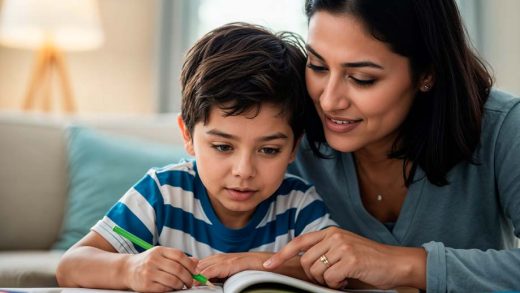
As parents, we often ask children questions to check what they know: What is this? What colour is it? How many are there? These questions have value, but children also need opportunities to explain how they reached an idea. Making thinking visible means encouraging children to express observations, reasoning, predictions, choices, and questions rather than simply giving the correct answer.
A visible thinking routine can be simple. It does not require worksheets, special equipment, or a formal lesson. It can happen during breakfast, a school journey, shopping, watering plants, reading a story, or watching rain from a balcony. The goal is to listen and talk about it.
How You Can Turn Everyday Moments Into Thinking Opportunities
Young children are constantly forming ideas about the world. When parents slow down and ask open-ended questions, children get space to explain those ideas. Instead of saying, “The clouds are dark because it will rain,” ask, “What do you notice about the clouds?” Then ask, “What do you think might happen next?”
This is a visible thinking routine because the child observes, predicts, and explains. There is no need to correct every answer immediately. If a child says something unexpected, ask, “What makes you think that?” The answer may reveal an interesting connection or misconception that can become a starting point for exploration.
Which Questions Help Your Child Explain Their Thinking?
Ask What Your Child Notices
“What do you see?”
“What is different?”
“What do you notice first?”
“What details caught your attention?”
Ask What Your Child Thinks
“What do you think is happening?”
“Why do you think that happened?”
“What makes you think so?”
“Could there be another explanation?”
Ask Your Child to Predict
“What do you think will happen next?”
“What might happen if we change this?”
“Which one do you think will sink?”
“How could we find out?”
Prediction is useful during play and simple experiments. A child building a tower, mixing colours, planting a seed, or arranging toys can make a prediction and compare it with what happens.
How Can You Use Everyday Questions During Indian Family Life?
You do not need a classroom-style activity to practise thinking routines. Everyday Indian family life offers rich opportunities. At the vegetable market, ask your child how they would group the vegetables. During a festival, ask what they notice about decorations, sounds, colours, food, or family traditions. While travelling, ask what they think people are doing and why.
At home, cooking can become a small investigation. Ask what might happen when an ingredient is heated, why dough changes texture, or how the family could divide snacks fairly. During monsoon mornings, ask why puddles appear and where the water might go later.
A visual thinking routine can make these conversations more engaging. Your child might draw what they noticed, arrange objects to show a pattern, create a simple diagram, or use blocks to represent an idea. The drawing does not have to be accurate. The explanation behind it matters more.
How Can You Encourage Reasoning Without Taking Over?
Parents naturally want to help when a child struggles. However, giving the answer too quickly can end the thinking process. Instead, offer prompts.
Ask, “What have you tried already?” or “What could you try next?” If your child builds a bridge that falls, resist rebuilding it. Ask, “Why do you think it fell?” and “What could make it stronger?”
You can also model thinking aloud. Say, “I am not sure which container will hold more. I think this one might, because it is taller. How could we check?” Your child hears that adults can make predictions, change their minds, and investigate questions.
What Are Some Examples of Visible Thinking for Preschoolers?
Simple visible thinking routines can fit naturally into play.
After reading a story, ask, “What do you think the character was feeling?” and “What makes you think that?” After building with blocks, ask, “What were you trying to make?” and “What would you change?”
During nature walks, ask children to notice something, make a prediction, and explain their evidence. During drawing, ask, “Tell me about your picture,” rather than guessing what it represents.
How Can You Connect Home Conversations With Preschool Learning?
When home conversations encourage curiosity and explanation, children experience learning as something they actively participate in. For parents, the lesson is not to recreate school at home. Instead, create a home environment where questions are welcome. A few thoughtful questions during ordinary routines can be more meaningful than a long worksheet session.
Read More: Thinking Flexibly: Why It’s Okay to Change Your Mind
Thinking Flexibly: Why It’s Okay to Change Your Mind
FAQs
What Ages Does Kangaroo Kids Cater To?
Kangaroo Kids offers programmes across the preschool years, including Playgroup for ages 2 to 3, Nursery for ages 3 to 4, Junior KG for ages 4 to 5, and Senior KG for ages 5 to 6.
What Learning Approach Does Kangaroo Kids Follow?
Kangaroo Kids uses its iCan Learning System and Fluidic Learning Methodology, focusing on flexible, child-centred learning experiences that recognise individual strengths and learning needs.
Last Thoughts
Visible thinking routine helps daily. Visible thinking routine questions can help. Helping children make their thinking visible begins with a simple shift: ask less about whether an answer is right and more about how the child arrived there. When parents ask what children notice, think, predict, remember, question, and would change, everyday moments become opportunities for deeper learning.
A visible thinking routine does not need to be complicated. It can begin with one question at breakfast and continue during play, stories, shopping, travel, nature walks, and family conversations. Over time, these habits can help children become more confident communicators and thoughtful learners.
For families who want to nurture curiosity, reasoning, creativity, and self-expression through everyday experiences, exploring the admission journey at Kangaroo Kids Preschool can help parents understand how role-play, storytelling, questioning, and play-based learning can make children’s ideas visible while giving them a structured environment to explore, communicate, and grow.