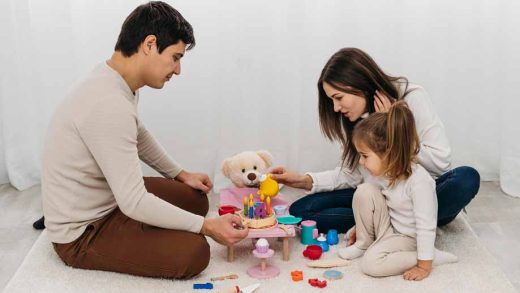
One afternoon, my daughter decided our teddy bear was very, very sick. She tied a dupatta around her shoulders, grabbed her toy stethoscope, and made me wait outside until my “name” was called. I asked what was wrong with the bear. She sighed, scribbled in her little notebook, and told me he needed rest and “more laddoos.”
I almost laughed, but then stopped. I realised that in the moment, she wasn’t only playing doctor. She was learning language, empathy, memory, and even problem-solving. And I thought to myself: play in early childhood education is probably more powerful than half the “serious” lessons we sign kids up for.
Why Is Play Important for Children?
It’s a fair question. We grew up hearing “Go play outside” as if play was something extra, a break from “real” work. But the truth is, children build life skills through it.
Think of pretend play:
- They build language by inventing conversations.
- They sharpen social skills by negotiating roles (“I’ll be the teacher, you be the naughty student”).
- They tackle problems without realising it—how to keep a game going, how to make sense of a story.
The importance of play in child development isn’t just theory. Anyone who’s watched kids in action will see it. Sometimes you only notice years later.
Play Is a Serious Business
Kids take their games more seriously than we realise. When they run a “shop,” they’re not only acting cute. They’re counting, remembering, even marketing their “products.” When they cook imaginary meals, they’re practicing order—first chop, then stir, then serve.
I remember as kids, my cousins and I once turned a bedsheet into a “train.” One of us was the driver, someone else sold tickets torn out of a school notebook. We argued, laughed, and even cried when someone wanted to be the driver twice in a row. Looking back now, it wasn’t just timepass. It was teamwork, negotiation, and leadership all bundled in one messy “game.”
So yes, play benefits early childhood in more ways than we think. It is a serious business.
Types of Play in Children
Experts usually group play into a few types. If you’re a parent, you’ve probably seen all of these at home:
- Solitary Play – Your toddler sitting alone with blocks. Silent, but focused.
- Parallel Play – Two kids sitting side by side, each in their own world. It might be strange for you, but it’s super important.
- Associative Play – A little bit of sharing, a little bit of copying each other.
- Cooperative Play – Real teamwork—building forts, chasing games, planning together.
- Pretend Play – The star of the show. Kids step into roles and create entire worlds.
The last one—pretend play—pulls in language, creativity, and emotions all at once. That’s why educators treat it like gold.
Role of Play in Child Development
If you break it down, play in early childhood education feeds every part of growth:
- Cognitive: A pretend grocery shop = math practice without worksheets.
- Language: Every doll conversation adds new words.
- Emotions: “Being the parent” or “being the teacher” forces perspective-taking.
- Social: Kids learn how to wait, share, and compromise.
- Physical: Simple chasing games polish motor skills.
See the pattern? The role of play in child development is massive. Please don’t miss it or ignore it just because it’s hidden under giggles and costumes.
Everyday Examples Parents Will Recognise
- Tea parties: Kids actually rehearse hospitality and conversation.
- Doctor-doctor games: They slowly lose fear of hospitals and learn empathy.
- Pretend cooking: Teaches sequencing. Sometimes they also “feed” healthier meals than we do.
- Cushion forts: Planning, collaboration, sometimes sibling politics.
- Shops at home: From fake money to fake bargaining—it’s early economics.
Almost every Indian home has seen a child line up soft toys as “students” and shout like a teacher. That’s pretend play acting as rehearsal for confidence and communication.
Why Pretend Play Matters Today
Here’s the tricky part: gadgets. Kids are spending more time on screens and less time on free play. Pretend play balances that. It demands imagination. They have to create the scene themselves, not just consume it.
And for parents in cities, where safe outdoor play is shrinking, pretend play inside the home is a lifesaver. My daughter has travelled to space, run a restaurant, and been a school principal—all from our living room floor.
It also helps with emotions. After her vaccination, she came home and played “nurse,” giving shots to her dolls. She was processing fear in her own way. That’s powerful.
How Parents Can Encourage It
You don’t need fancy toys. In fact, everyday things work better:
- Old dupattas become superhero capes.
- Cardboard boxes become cars, houses, and sometimes even rockets.
- A steel bowl? That’s dinner ready for her dolls.
The main thing is time. Step back, let them lead. My 4-year-old once turned a broom into a horse and rode it around the house nonstop. That broomstick gave her more imagination than any “educational toy” we’ve bought.
The Aha Moment for Parents
Here’s the truth: play is not a break from learning. It IS learning. The sooner we see play as a serious business, the easier it becomes to value those “pointless” pretend games.
So next time your child asks you to be the “customer,” play along. Those minutes count more than we realise.
Final Thoughts as a Parent to Another Parent
Play benefits early childhood in ways textbooks can’t. It builds resilience, creativity, problem-solving, and social intelligence. And all without a child even realizing they’re learning.
Our role is to give them props, space, and the freedom to go wild with imagination.
A Note from Kangaroo Kids International Preschool
At Kangaroo Kids International Preschool, pretend play isn’t an afterthought—it’s central.
Our classrooms are built to let children imagine, explore, and grow, while shaping strong foundations for the years ahead. You should definitely consider us for your child while deciding on a preschool.