In classrooms across India, the educational landscape is shifting from teacher-centric instruction toward learning environments in which students learn with and from one another. This shift acknowledges that the benefits of collaborative learning extend beyond memorising facts; they cultivate essential interpersonal and cognitive skills that prepare children for school, social life, and future careers.
In fact, modern Indian education, from progressive CBSE schools to government initiatives, increasingly recognises the power of student collaboration not just for academic success but for whole-child development.
Here, we will examine in detail what collaborative learning entails, why it matters in the Indian context, and how simple peer-learning activities and structured projects foster deeper understanding, higher motivation, and improved social skill development.
What Is Collaborative Learning?
Collaborative learning is a pedagogical approach in which learners work together to solve problems, complete tasks, or create products. This approach emphasises shared responsibility, collective thinking, and mutual accountability. Rather than passively receiving knowledge from teachers, students actively engage with one another to construct understanding and co-solve challenges.
At its core, collaborative learning moves beyond simple tasks such as sharing materials or classroom time. From designing a poster to building a large block tower together to discussing interpretations of a story, it involves working together to think, question, negotiate, reason, and develop solutions.
Why Collaborative Learning Benefits Are Critical in India
India’s classrooms are rich in linguistic, cultural, and socioeconomic diversity, and students bring a wide array of perspectives to learning environments. In such a context, collaborative learning plays a vital role in fostering understanding across differences and encouraging respect for divergent viewpoints.
Moreover, many educational reforms in India, including aspects of the National Education Policy (NEP) 2020, emphasise problem-solving, critical thinking, and project-based learning—each of which is closely tied to collaboration among students rather than to teacher-led methods.
Research also confirms that group work and shared enquiry improve communicative competence and deepen conceptual understanding of the core outcomes of collaborative learning.
Sharing Is Just the Start: Real Problem-Solving Happens Together
At the earliest stages of education, children learn simple forms of cooperation, such as sharing crayons or taking turns during preschool group activities. While sharing is an important social milestone, true collaborative learning benefits emerge when children solve problems together.
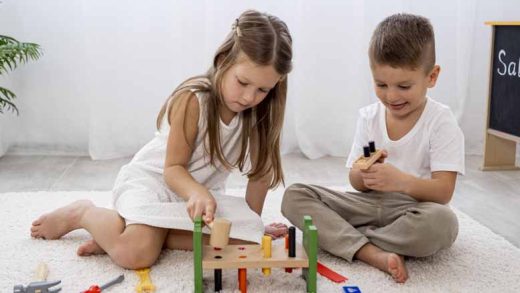
Consider a classroom block area in which children decide to build a large block tower. One child may begin with a design idea; another may notice balancing issues; a third may offer suggestions about material placement. Through mutual negotiation and trial and error, the group deepens its understanding of balance, structure, and perspective.
This dynamic involves:
- Listening to others’ ideas
- Testing and refining strategies
- Communicating outcomes clearly
- Taking collective responsibility for success and setbacks
These experiences teach children that multiple minds together can find more robust solutions than working alone. This is the cornerstone of collaborative learning benefits.
Academic Advantages of Collaborative Learning
Collaborative learning enhances traditional academic skills in ways individual study rarely does:
[ 1. Deep Understanding and Retention
When children explain concepts to each other, they process information more actively than when they memorise it individually. Studies show that students involved in group discussions and shared tasks often demonstrate deeper understanding and recall.
[ 2. Encouraging Critical Thinking
Through dialogue and debate, students compare ideas, question assumptions, and evaluate alternative solutions, thereby strengthening critical thinking. This form of cognitive engagement is a powerful component of the benefits of collaborative learning.
[ 3. Motivation and Engagement
Learning with peers makes education interactive and engaging. Students often feel more motivated when they contribute to a group project than when they work alone, because social collaboration itself becomes stimulating and rewarding.
Peer Learning Activities: Beyond the Classroom Walls
Peer learning activities harness shared experiences and diverse perspectives, making education richer and more interactive. Examples include:
- Peer discussion circles on reading comprehension
- Paired problem solving in maths
- Small group science experiments
- Collaborative storytelling or role-play
These activities encourage students to articulate their thinking, listen to others, and negotiate meaning, each a powerful expression of the benefits of collaborative learning in action.
Social Skills Development Through Collaboration
Collaboration doesn’t only improve academic performance, but it also nurtures social skills development. Through peer interaction, students learn:
- Courtesy in communication
- Emotional regulation
- Conflict resolution
- Empathy and perspective-taking
- Shared leadership and followership
In India’s relationally rich educational contexts, where teamwork and interpersonal harmony are valued, these skills translate directly into effective interactions outside the classroom: in homes, communities, and future workplaces.
Indian Initiatives Supporting Collaborative Models
Across India, educational policies and innovations are recognising the importance of collaborative approaches. For instance:
[ Student Clubs to Promote Collective Learning
In Maharashtra, schools will soon establish mandatory student clubs to foster leadership and teamwork, in which learners collaborate on academic and extracurricular pursuits, illustrating how group engagement is being institutionalised in education, as reported in this Times of India article.
[ Social-Emotional Learning in Curricula
Programs such as Delhi’s Happiness Curriculum incorporate social-emotional and interpersonal skills into daily learning, including mindfulness and cooperative problem-solving. This strengthens the context for collaborative learning benefits.
These developments show that collaborative learning is not merely a pedagogical idea, but a growing structural priority.
Classroom Techniques to Build True Collaboration
To harness collaborative learning benefits effectively, teachers and parents can embed structured group engagement throughout the learning day. Here’s how:
- Group Problem-Solving Tasks: Rather than asking each child to answer individually, assign small-group challenges, such as puzzles, project designs, or practical investigations, that require shared ideation.
- Dialogue-Based Learning: Encourage students to discuss viewpoints openly, using protocols such as “listen before you speak” and “ask clarifying questions,” which enhance both understanding and respect.
- Roles Within Groups: Assign specific roles to students, such as recorder, presenter, critic, and facilitator, so that each child contributes and learns different aspects of group participation.
- Reflection on Group Processes: After group activities, prompt students to reflect: What worked? What didn’t? How did we solve disagreements? This reflection reinforces the why behind collaboration.
- Teacher as Facilitator, Not Sole Expert: In collaborative settings, teachers guide rather than dictate. They pose questions, scaffold discussions, and ensure equitable participation, all of which are key to nurturing lasting collaborative habits.
These techniques help extend collaborative learning benefits beyond activity completion to meaningful, transferable habits of thinking.
Beyond Sharing: Collaborative vs. Cooperative Models
It’s important to note that collaboration is more than sharing. While sharing means dividing resources or time, true collaboration involves mutual problem-solving and cognitive engagement. In collaborative settings, students:
- Exchange reasoning
- Build on each other’s ideas
- Challenge assumptions respectfully
- Jointly evaluate solutions
This is where collaborative learning benefits truly emerge — through shared construction of knowledge rather than merely dividing work.
Challenges and Remedies in Indian Settings
While collaborative learning is valuable, schools and families may face challenges:
- Uneven participation — Some students dominate while others hold back
- Assessment — Evaluating individual contributions in group work
- Infrastructure limitations — Space or resources for group activities
To address these:
- Teachers can design structured roles to balance contributions
- Rubrics can assess both group outcomes and individual skills
- Classrooms can use flexible seating or breakout areas for collaboration
Overcoming these hurdles ensures that collaborative learning benefits reach all students equitably.
Preparing Students for the Future Through Collaboration
In a globally connected world, technical knowledge alone is not enough. Employers increasingly seek individuals who communicate clearly, work effectively in diverse teams, and adapt to shared problem-solving scenarios.
Collaborative learning benefits directly contribute to these competencies, helping students become:
- Effective communicators
- Team players
- Creative problem solvers
- Skilled negotiators
These are essential attributes for success not only in higher education but in careers spanning business, science, health, technology, and community leadership.
Collaborative Learning in Early Years and Preschool Contexts
Even at young ages, group activities for preschoolers, such as building a large block tower, sorting objects together, or cooperative art projects, introduce children to shared cognition.
These activities reinforce:
- turn-taking
- shared planning
- negotiation through language
- emotional regulation in teams
Such early foundations are vital, as social integration, cooperation, and active participation become natural parts of children’s learning identities.
A Lifelong Skill Built on Today’s Experiences
The advantages of peer-to-peer engagement extend far beyond primary school. Children who experience collaborative learning early are more likely to:
- Seek multiple viewpoints
- Approach problems with adaptability
- Feel confident in group challenges
- Engage respectfully with peers from diverse backgrounds
In this way, collaborative learning benefits foster not only academic growth but character and citizenship.
Collaboration as a Bridge to Deeper Learning
In India’s educational ecosystem, which is rich in diversity, cultural complexity, and evolving pedagogy, collaborative learning stands out as a transformative approach. By engaging students in shared inquiry, structured group tasks, and sustained peer interaction, schools and families help children transcend rote memorisation and develop meaningful skills.
Collaborative learning benefits include stronger academic understanding, enhanced social skills, greater motivation, and deeper problem-solving.
By emphasising peer dialogue, group problem-solving, and respectful cooperation, India’s educators and parents can prepare children not only to succeed in examinations but also to excel in life’s complex, collaborative challenges. This is to build not just knowledge, but connected, empathetic, capable learners.
At Kangaroo Kids, our curriculum emphasizes collaborative models that teach children the power of peer-to-peer connection.