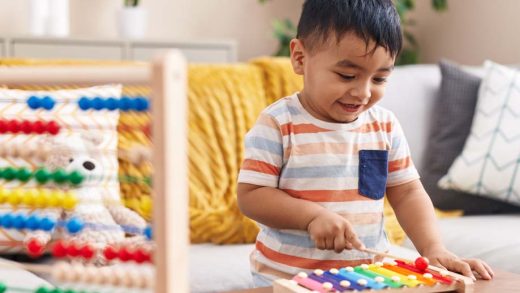
My children love walking around the house and turning the exercise into a little maths game. A plate became a circle, a window became a rectangle, and a box suddenly became something worth examining from every angle. Children often understand mathematical ideas best when they can connect them to objects. I noticed that when their cousins came to visit, they would invite them to play and turn it into a tournament. Learning shapes and 3d shapes can begin with exactly that kind of curiosity.
Why Should Indian Parents Teach Children About Shapes?
Shapes and 3D shapes are among the earliest mathematical ideas children encounter. They help children describe objects, understand space, recognise patterns, and develop visual thinking. Comparing 2D and 3D shapes becomes easier when children can touch, draw, build, and sort them.
One way to explain shapes and 3D shapes to children is to start with dimensions. A 2D shape is flat and can be drawn on paper. A 3D shape has length, width, and depth, so it takes up space. For young learners, repeated exposure matters. Seeing the same shape in different sizes, colours, positions, and materials helps children understand that its identity depends on its defining features, not appearance or orientation alone.
What Are Common 2D Shapes for Kids?
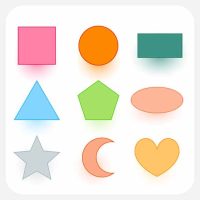
2D shapes have length and width but no depth. Introduce them through everyday objects rather than definitions alone.
Circle
A circle is round and has no corners or straight sides. Examples include plates, wheels, coins, clocks, and bangles.
Square
A square has four equal sides and four corners. Tiles, windows, boxes, and some floor patterns can help children recognise it.
Rectangle
A rectangle has four sides and four corners, with opposite sides equal. Books, doors, tables, and mobile screens are useful examples.
Triangle
A triangle has three sides and three corners. Children can spot triangles on kites, road signs, bunting, and rooftops.
Oval
An oval is a rounded shape that looks like a stretched circle. Eggs, balloons, mirrors, and some leaves are familiar examples.
What Are Common 3D Shapes for Kids?
Once children understand flat shapes, introduce 3D shapes they can handle. You can connect 2D and 3D shapes by showing how flat surfaces appear on solid objects.
Cube
A cube has six equal square faces, twelve edges, and eight corners, also called vertices. Dice, building blocks, and some gift boxes are easy examples.
Cuboid
A cuboid, also called a rectangular prism, has rectangular faces. Cereal boxes, books, cartons, and many packages have a similar form.
Sphere
A sphere is completely round, with no flat faces, straight edges, or corners. Balls, oranges, and some decorative objects provide familiar examples.
Cylinder
A cylinder has two circular flat faces and one curved surface. Cans, drums, bottles, and some containers can help children identify it.
Cone
A cone has a circular base and a curved surface that narrows to a point. Ice cream cones, party hats, and some traffic markers are familiar examples.
Pyramid
A pyramid has a base and triangular faces that meet at a point. Children may recognise pyramid forms in models, toys, or pictures of famous monuments.
How Can Parents Explain the Difference Between 2D and 3D?
Use objects children can see. Draw a circle on paper, then place a ball beside it. Explain that the drawing is flat while the ball has depth and occupies space.
Comparing 2D and 3D shapes becomes easier. Ask children which objects can roll, which can stack, and which have flat surfaces.
How Can Indian Parents Use Everyday Activities?
For Indian families, a shape hunt can work anywhere. At home, ask children to find a circular chapati, a rectangular book, a cylindrical container, or a cuboid package. During a walk, look for circular wheels, triangular signs, rectangular doors, and other familiar forms.
During Diwali, children can identify shapes in rangoli patterns and decorations. While shopping, they can examine boxes, tins, bottles, and packets.
How Does Kangaroo Kids Approach Early Maths?
Kangaroo Kids uses an E-L-P-S approach, meaning Experience, Language, Picture, and Symbol, to help children build and connect mathematical concepts with real-world situations. Its Fluidic Learning Methodology also keeps learning flexible and responsive to individual strengths.
This can make shapes and 3d shapes feel meaningful rather than abstract. Children can experience objects, talk about what they notice, represent ideas visually, and gradually connect them with mathematical language and symbols.
What Fun Shape Activities Can Parents Try?
Try a Shape Sorting Game
Collect household objects and ask children to sort them into flat and solid groups. Then sort the solid objects into items that roll, stack, or do both.
Build and Draw Shapes
Use blocks to build cubes and cuboids, then draw their faces on paper. Children can also create triangles, squares, and rectangles using sticks, craft materials, or magnetic tiles.
Play a Shape Hunt
Give children a list of shapes and ask them to find examples around the home. Older children can explain why an object belongs to a particular category.
Read More: How Can Preschool Math Printables Make Learning Numbers Fun and Engaging?
FAQs
What Learning Approach Does Kangaroo Kids Follow?
Kangaroo Kids follows the iCan Learning System and includes mathematics, language, creativity, STEAM, Future Skills, and Habits of Mind within its curriculum. Its mathematics programme uses E-L-P-S to connect concepts with real-world experiences.
What Ages Does Kangaroo Kids Preschool Cover?
Kangaroo Kids lists Playgroup for ages 2 to 3, Nursery for 3 to 4, Junior KG for 4 to 5, and Senior KG for 5 to 6.
Last Thoughts
Learning shapes and 3d shapes gives children a foundation for understanding geometry, space, patterns, and everyday objects. Keep lessons practical, conversational, and playful. Whether children are spotting shapes in a rangoli, sorting kitchen containers, building with blocks, or drawing pictures, repeated real-world experiences can strengthen their understanding.
For parents who want to nurture creativity, communication, curiosity, and mathematical thinking through structured play and hands-on learning, exploring the admission process at Kangaroo Kids Preschool can offer valuable insight into how everyday discovery, exploration, and meaningful experiences can help children understand concepts with confidence today.