Children often learn colours best when they can touch, see, sort, move, and create. A red flower, green leaf, yellow school bus, or blue water bottle can become a natural teaching moment. Colour recognition activities help preschoolers develop observation, vocabulary, memory, attention, and early classification skills.
For families, colour learning can happen anywhere. Children can notice colourful rangoli, fruits and vegetables at a market, clothes during festivals, flowers at a temple, or toys at home. These familiar experiences make learning meaningful and enjoyable.
How Can Parents Begin Teaching Colours?
Start with a few familiar colours. Choose objects your child sees regularly and name the colour clearly. Say, “This is a red apple,” then invite your child to find another red object.
Repeat the words during meals, play, walks, and dressing. Once your child becomes confident, introduce comparisons such as light and dark, or ask which of two objects has a brighter shade.
Which Simple Colour Recognition Activities Can You Try?
Make a Colour Sorting Basket
Take three or four baskets, bowls, or containers and assign one colour to each. Give your child safe household objects such as blocks, bottle caps, socks, or toys. Ask them to place each item into the matching basket.
This activity develops sorting and visual discrimination. It also gives children opportunities to explain their choices.
Create a Colour Hunt
A colour hunt can turn an ordinary walk into an investigation. Choose one colour and ask your child to find five objects with that colour. Repeat the game with different colours.
Children might find green coriander, a red cushion, a yellow toy, or a blue lunch box. The activity encourages movement while strengthening vocabulary.
Try a Colour Identification Activity
A simple colour identification activity can use paper circles, crayons, paint samples, or coloured cards. Place several colours in front of your child and name one. Ask them to point to the matching card.
Later, reverse the activity. Point to a card and ask your child to name the colour. This helps move learning from recognition towards recall.
How Can You Turn Colour Learning Into a Game?
Play a Colour Identification Game
You can play a colour identification game with toys, clothing, stationery, or objects around the room. Say, “Find something blue,” and give your child time to search. For a challenge, give two instructions, such as “Find something red and yellow.”
You can also play “What Changed?” Place three coloured objects together, let your child observe them, then hide one. Ask which colour is missing. This builds memory and attention.
Use a Colour Matching Game
Create pairs of coloured cards or objects and mix them together. Ask your child to find matching pairs. Younger children can begin with two or three colours, while older preschoolers can handle more.
Matching supports visual discrimination.
How Can Indian Parents Use Festivals for Colour Learning?
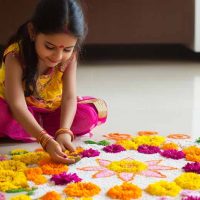
Festivals provide opportunities for colour exploration. During Holi, children can notice shades and how colours look together. During Diwali, they can identify colours in rangoli designs, flowers, diyas, decorations, and clothing. Navratri can introduce a different colour each day.
These experiences connect learning with traditions. You can ask them, “Which colour do you see most?” or “Can you find two objects with the same colour?” Such conversations encourage children to observe and describe their surroundings.
Can Art Help Children Recognise Colours?
Art gives children opportunities to see, name, compare, and use colours. Provide crayons, washable paints, coloured paper, or recycled packaging and invite children to create freely.
Instead of telling children exactly what to draw, ask open-ended questions. “Which colours would you like to use?” “What happens when you mix these colours?” and “Can you find a colour that looks similar?”
These questions encourage experimentation and reinforce colour vocabulary.
How Can Parents Make Activities Suitable for Different Ages?
For younger preschoolers, focus on matching and naming a few basic colours. Keep activities short and repeat words. For older preschoolers, introduce sorting by colour and size, or ask children to create patterns.
Children develop at different rates. Avoid turning colour learning into a test. If a child confuses colours, offer more opportunities to explore without criticism.
How Does Kangaroo Kids Support Learning Through Exploration?
Kangaroo Kids encourages children to learn through exploration, creativity, communication, and hands-on experiences. Its preschool programmes give children opportunities to think, ask questions, discover, experiment, create, and role-play.
Colour recognition activities fit this approach because they combine art, language, mathematics, movement, and observation. Children can sort objects, create patterns, describe pictures, explore colour mixing, and discuss what they notice.
The goal is to help children become confident observers who identify differences, make connections, and communicate what they see.
Read More: What Are the 9 Navratri Colours? Day-Wise Colours and Their Significance
FAQs
What Ages Does Kangaroo Kids Cater To?
Kangaroo Kids offers Playgroup for children aged 2 to 3, Nursery for ages 3 to 4, Junior KG for ages 4 to 5, and Senior KG for ages 5 to 6.
What Learning Approach Does Kangaroo Kids Follow?
Kangaroo Kids uses its iCan Learning System and Fluidic Learning Methodology to support child-centred learning through exploration, creativity, communication, and play.
Last Thoughts
Colour recognition activities can make learning active and enjoyable. When children sort toys, hunt for colours, match cards, create artwork, or explore festival decorations, they are developing more than colour vocabulary. They are also practising observation, memory, communication, classification, and independent thinking.
For parents, the approach is often the most effective. Use familiar objects, ask questions, repeat colour words, and give children plenty of opportunities to explore.
Colour recognition activities become especially meaningful when children can connect what they learn with everyday life. A market visit, a rainy-day walk, a family celebration, or a simple art session can all become learning opportunities.
Parents who want to nurture creativity, communication, and imaginative learning through art, stories, play, and hands-on experiences can explore the admission process at Kangaroo Kids Preschool to understand how structured play-based learning helps young children observe, express, and understand their world.