In early childhood, movement isn’t just play; it’s the foundation of how a child’s brain and body grow together. Unfortunately, even in modern India, academic pressure can sometimes overshadow physical play.
Research and educators increasingly highlight that gross motor skill development is central to a child’s physical strength, coordination, and neurological development. Movement helps young learners build muscles, refine balance, and reach developmental milestones, all while stimulating the brain in ways that sitting still never can.
Here, we will explore how movement drives learning, why it matters in the Indian context, and how parents and educators can support children’s growth through active play.
What Are Gross Motor Skills?
Gross motor skills development refers to the strengthening and coordination of large muscle groups involved in activities such as crawling, walking, running, jumping, and climbing. These are the building blocks of physical ability that allow children to move through the world confidently and independently.
Unlike fine motor skills, which involve small, precise movements, gross motor skills involve large, coordinated movements. Developing these abilities strengthens muscles, improves balance, and promotes coordination, making everyday tasks easier and more enjoyable for children.
The Brain-Body Connection: Movement and Neural Growth
Did you know that movement does far more than increase fitness? Movement actively stimulates brain growth and neural connections. When children run, jump, or balance, their brains send signals between neurons, forming lasting pathways.
This neural strengthening supports cognitive capacities such as attention, memory, and problem-solving. Research on physical movement and brain development indicates that physical activity in the early years enhances neural connections crucial for learning and memory.
In India, where children increasingly spend time indoors, encouraging regular movement is essential. Physical play promotes essential brain development, enhancing focus and school readiness.
Movement Matters for Physical Development in Early Childhood
Building Muscles, Balance, and Coordination
From the first time a baby rolls over, the road to mobility begins. In infancy and toddlerhood, gross motor skills development unfolds through a sequence: lifting the head, rolling over, sitting up, crawling, and eventually walking.
As children grow, more advanced motor skills such as running, hopping, and climbing develop. For example, toddlers between ages 3 and 5 can typically hop on one foot, balance briefly, and catch a ball.
These milestones reflect not only physical readiness but neurological development. Movement builds core muscle strength and balance, which are essential for later tasks like writing or participating in sports.
Strengthening the Brain Through Movement
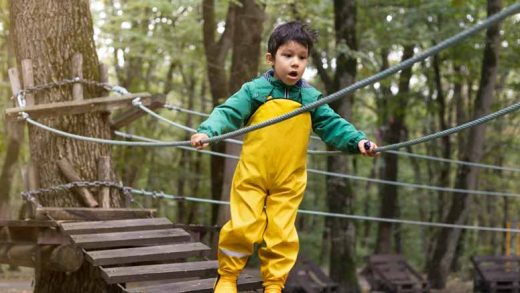
Physical activities like running, hopping, and climbing help the brain learn how to process information. When a child manoeuvres an obstacle course or balances on a beam, they are training their brain to respond to sensory input, make decisions, and adapt to new challenges.
Why Movement Is Essential for Kids’ Overall Growth
Stimulating Cognitive Development
Beyond physical gains, gross motor skills development plays a significant role in cognitive growth. As children move, their brains engage in complex processing that helps develop functions like focus, memory, and problem-solving.
Movement primes the brain for closer focus and improved memory, and these benefits will carry through to classroom activities and homework.
Emotional and Social Benefits
Physical movement also stimulates emotional health. Active children are more likely to express confidence, cope with frustration, and participate in social play. Cooperative games and playtime with peers help children learn teamwork, empathy, and healthy competition.
Encouraging Movement at Every Stage
Movement from Infancy to Preschool
From birth, children benefit from activities that encourage movement.
- Crawling and rolling: Tummy time, reaching for toys.
- Walking independently: Encouraging movement in safe spaces.
- Balancing on one foot: Hopscotch or balancing games.
- Climbing and jumping: Playground structures and obstacle courses.
Each stage of movement reinforces neural connections that support higher-order brain functions.
The Importance of Movement for Kids in the Indian Context
In many Indian cities, academic routines can limit time for physical play. Yet the benefits of movement are undeniable. Preschools and early learning centres across India are increasingly incorporating physical play into daily schedules.
Outdoor play, ball games, nature walks, and dance sessions not only aid physical development but also stimulate cognitive growth through active engagement.
Brain Development Activities Through Movement
Movement doesn’t have to be organised sports. Playful, everyday activities can act as powerful brain development activities:
- Ball games: Improves balance, coordination, timing, and spatial skills.
- Nature walks: Helps children refine balance and proprioception.
- Obstacle courses: Enhances motor planning and problem-solving.
- Dance and rhythm games: Strengthens timing, coordination, and self-expression.
The Role of Parents and Educators
Creating Movement-Rich Environments
Parents and teachers play a central role in nurturing gross motor skills development. Simple changes, such as daily outdoor play or incorporating active games into routines, can make a huge difference.
Encouraging Daily Movement Habits
Families can integrate movement into everyday life. Short walks, playful chase games, and active chores all add up to important motor practice.
Movement as a Foundation for Growth
Gross motor skills development is not a luxury; it’s a necessity. Through movement, children build muscles, refine coordination, and stimulate brain growth in powerful ways.
Encouraging active play, outdoor exploration, and joyful physical challenges helps young learners grow stronger in body and sharper in mind. At Kangaroo Kids, we incorporate movement-based learning to ensure holistic development for every child.