When I had my daughter, I assumed that most learning would start only after she joined school. I imagined handwriting books, numbers on a slate, and reciting the ABCs. But as I watched her, I realized something bigger was happening long before that.
The way she used a lemon as a ball, mumbled rhymes while tearing a newspaper, squatted in the garden to observe the tiniest insect, or bombarded me with a thousand “whys”—it made me pause. Her brain was working at full speed, soaking in every detail. That’s when I truly understood why early education is important.
Many parents ask: If children will eventually go to school, why do these early years matter? Science gives us the answer. Between birth and age six, the brain builds more connections than it ever will again. These are the foundation years—once gone, they don’t come back.
In this blog, let’s look at the benefits of early childhood education, with real-life moments most parents will instantly relate to.
Clapping, sorting, rolling—it’s all learning
From birth to six, children absorb information at a rate that’s hard to imagine. But unless experiences are repeated, they fade. That’s why play is powerful—it wires the brain again and again.
Don’t hold back from messy play. Get your hands dirty with them, clap along, ask silly questions, let them run and roll. Every bit of it is learning.
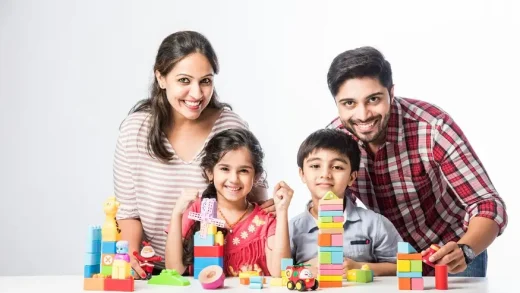
Think about a game of clapping in rhythm to a rhyme. For us, it’s a small activity. For them, it’s coordination, sound, memory, and joy. Sorting blocks by color is not just fun—it builds categorization and problem-solving.
When my daughter was three, she began sorting her toy animals “by who eats grass and who eats meat.” She wasn’t simply playing—she was creating her own way of understanding the world. That’s what early learning benefits really look like.
Even when they’re not listening, they’re listening
One piece of advice from my daughter’s doctor still rings in my ears: “Just keep reading to her. Even if she’s just rolling on the floor, chewing her toy strawberry, or tearing away the newspaper — it doesn’t matter. She’s listening.”
At first, I doubted it. But then, despite never sitting still during storytime, she could suddenly narrate entire stories back to me. She had absorbed it all without looking at me once.
And this isn’t just a parent’s story—it’s proven. Research by the American Academy of Pediatrics shows that the number of words a child hears in her initial years – in the form of rhymes, songs, read-aloud stories, general talking, or absolutely any form of communication and yes, in any language – affects brain development massively.
So the next time you read aloud and think, “What’s the point? She’s not even listening,” remind yourself – it is all going in. One day, you’ll be surprised when your child repeats a story you thought went unheard.
Small incidents can teach big lessons
We Indian parents, most of us, put a lot of focus on academics. It’s great, but we often don’t give emotional growth enough importance. A lively classroom can be the first place where the emotions of a child actually start blooming. I’ll give you an example. One day, my daughter, who was around 4 at that time, came home and told me about a little incident. She had gotten really upset when another child had snatched her favorite crayon from her. But her teacher gently encouraged her to talk about her feelings and maybe pick another shade, and also told the other child that he could have asked her to share that crayon politely instead of snatching it. This simple resolution, which seems “simple” to us, is not for the kids at that age. That tiny moment taught her about sharing and patience in a way I couldn’t have at home.
Falling blocks build stronger brains
Early education encourages children to solve problems instead of handing them answers. When a tower of blocks keeps collapsing, a teacher might simply ask, “What can you change to make it stand?” That moment of figuring out strengthens your child’s mind, pushing it to think, “What should I do?”
I saw this at home too. On a rainy afternoon, my daughter taped strips of paper across the balcony because she didn’t want her toy cars to skid. This act showed that kids are born problem solvers. She had identified the problem and also the solution on her own, no nudging, nothing. And the best part was she didn’t ask for any fancy stuff – just the old newspaper lying around was good enough to do her job!
Friendships are lessons too
Preschools are indeed the first place in a child’s life, which is like a home outside home. It’s where they learn to share, talk, appreciate, negotiate, comfort a crying friend, or just listen.
I saw this firsthand when I went to drop my kid off at an after-class dance practice that was being held. I saw three of her classmates who had come for rehearsal. When they all met, they jumped in joy. During their break, they just played in the small play area – one rolled a clay ball, another flattened it, and the third decorated it. Nobody told them to collaborate — they just did. That’s how early social environments naturally shape teamwork, empathy, and respect.
Focus is a muscle—they build it early
Parents often ask me, “Does preschool really help improve focus?” The answer is YES. Activities like puzzles, drawing, or sitting through a story train children to sustain attention.
I still remember my daughter spending nearly 20 minutes piecing together a floor puzzle of India’s map. Every time she got a state right, she beamed. By the end, she wasn’t just learning geography—she was learning persistence.
Focus doesn’t come overnight. It’s a muscle built through small, repeated tasks like these.
Learning should feel like play, not pressure
Children who grow up in joyful learning environments carry that attitude into mainstream school and beyond. They see learning as an exciting, fun thing, not a burden.
One of my relatives decided to delay preschool for her twins, thinking she could teach them everything at home – unfortunately, they didn’t get much exposure interacting with more kids their age or in a school set-up. Please note – homeschooling can be great, but it does need a different structure and more mindspace and involvement from the parent. Coming back to the case, by the time the kids entered school, they struggled with group routines and adjusting to structured settings. It wasn’t really about intelligence — it was about missing that early exposure to shared learning.
That’s why the benefits of early childhood education are not about rushing academics. They are about nurturing curiosity, so children naturally love learning.
Early education gives every child a fair start
In India, children grow up in vastly different environments. Some are surrounded by books and conversations daily, while others have fewer opportunities. Early education bridges this gap.
As a parent myself who has been fortunate to send her child to a great preschool and seeing how it really helped, I strongly feel every child, no matter their background, should get to go to a preschool where they can do and learn so much more – interacting, reading, playing, listening, and more. You ask any experienced parent, and they will totally vouch for the early learning benefits that only a preschool can provide.
Shoelaces today, skills for tomorrow
It feels totally weird to talk about “future jobs” when your child is still learning to hold the pencil correctly, but it’s true. Early education nurtures creativity, adaptability, and collaboration — the exact skills tomorrow’s world will demand.
With technology and AI reshaping careers by the minute, rote memorization won’t take them or anyone far. Only the sharp and focused ones can survive. And how can we help here? By making our children curious, confident, and flexible, they can adapt to whatever the situation may be tomorrow.
Why early education is important—now you see it
When you connect the dots, it’s clear why early education is important. These years aren’t about worksheets or grades. They’re about building neural pathways, managing emotions, solving problems, and falling in love with learning itself.
Parents may not notice the results right away. But years later, you’ll see it—in the way your child handles challenges, relates to others, and approaches life.
A note for parents like me
In today’s day, the number of choices available can be super overwhelming. However, I’ve also come to realize that children don’t really need flashy gadgets or endless apps. What they need is a warm environment that blends play with discovery, and care with learning.
And that’s exactly what Kangaroo Kids International Preschool offers – a space designed to nurture brain development, creativity, and curiosity in the most natural way possible. If you’re looking for a place that respects and celebrates your child’s early years, Kangaroo Kids is a wonderful beginning.